

Start Your Journey
What you need, gameplay and the rules for the Beta version
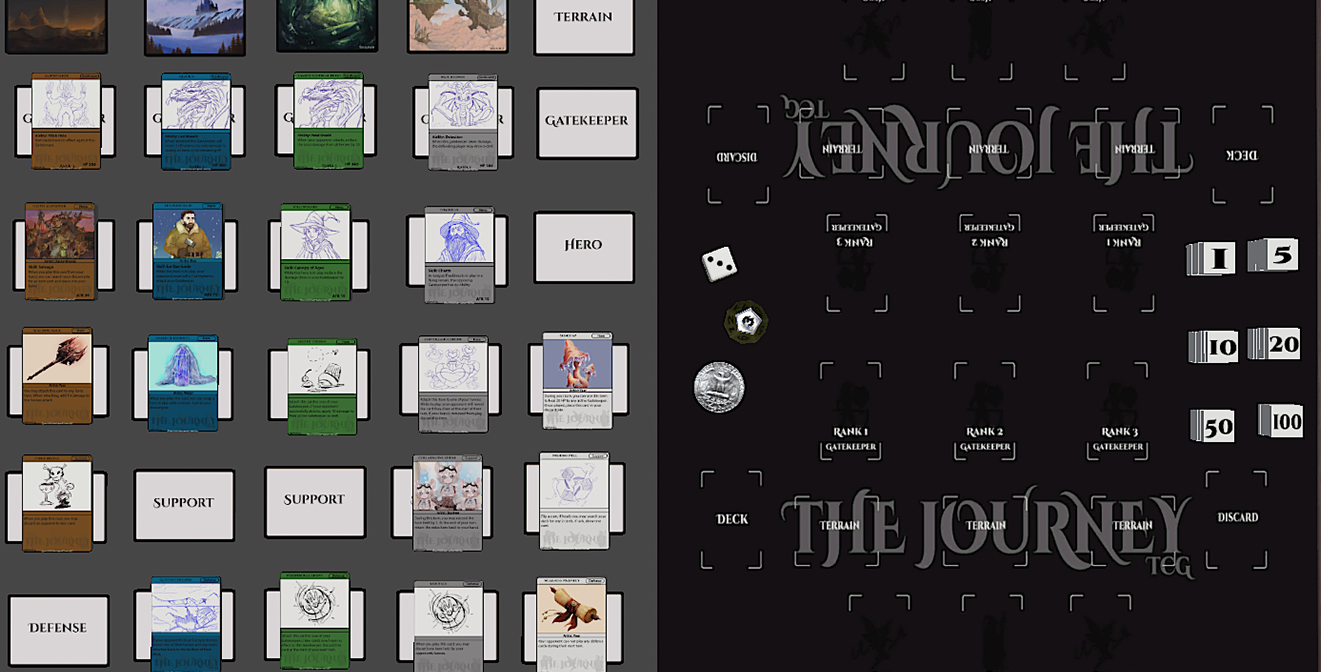
Try it online today!
You can be one of the first to play the Beta test on Table Top Simulator! We are still in development and not all of the artwork is completed, but we have set up TTS with two versions. First is a deck building table that has every card we currently have in development. The second is a table with two pre built decks. All we ask is you send us some feedback after your games in the form provided below!
Have feedback about the gameplay or cards?
We want to hear it! You can tell us what you like, what you don't like, what you think needs to change in the feedback form. We need as much input as possible from the community to ensure the game is enjoyable for all when it officially releases.
What do you need to get started?
Decks
Each players deck should contain 60 cards. These cards should include Heroes, Defense, Support, and Item cards. Each players deck may not contain more than 4 cards with the same name.
Gatekeepers
Additionally each player will have 3 Gatekeeper cards, one rank 1, one rank 2, and one rank 3. Gatekeepers are used defensively and used to guard the active Terrain.
Terrain Cards
Each player will also have 3 terrain cards. Terrain cards are used to determine which land type the players are in for all Heroes and Gatekeepers that are currently in play.
Damage Counters, a Coin and a D12
To play the game you need counters to keep track of the amount of damage on the Gatekeepers. A coin will also be required to determine heads or tails. And a D12 for rolling chances built into the cards.
Setting up the playmats
At the start of each game, players will begin by setting up their playmats.
Once the play order has been determined, and the player going second has placed the first terrain card, both players will place their Rank 1 Gatekeepers in the corresponding Gatekeeper spaces.
Example image of what each players playmat should look like below.

Different Card Types
Hero Cards
A Hero card is the primary way to deal damage each turn. Hero cards may also have skill effects while being played in their matching terrains. Ensure you read each card carefully.
Gate Keeper Cards
A Gatekeeper card is used to defend terrains. Each will have a rank assigned to it and have an HP Stat. Each Gatekeeper card may also have ability effects while being played in specific terrains. Ensure you read each card carefully.
Terrain cards
Terrain cards are used to determine what the active Terrain type is. The Terrain effects all Heroes Gatekeepers. Terrain cards may be changed through the game by different gameplay mechanics which may effect both the Heroes and or Gatekeepers.
Support, Defense and Item Cards
Support and Defense cards are used to do just that. Support you on your journey or try to defend against your opponents. Ensure you read each card carefully to ensure you are playing it correctly.
Item cards once played have a variety of effects. Some are only played for one turn, while others can stay in the game for longer periods of time.
Starting Your Journey
Once your playmats are set up you are ready to start your journey.
Players will shuffle their decks and place them face down on the left side of the playmat.
Determine the player who will go first by flipping a coin or a dice roll. The player that wins the coin toss chooses if they play first or second.
Both players will draw 7 cards from their deck to begin the game.
During each players turn they will start by drawing 1 card from the top of their deck. They may then play 1 Support card, 1 Defense card, 1 Item card and 1 Hero card in any order. However the player that goes first is not able to play a Defense card on their first turn. Furthermore, Heroes and Gatekeepers may only have 1 Item card that equips or attaches to them at a time.
A player's turn ends if they attack with their hero(es), or they signal that they are ending their turn. When attacking, the attack power is the total of all active heroes in play.
A Gatekeeper is defeated when its HP is reduced to zero. When a Gatekeeper is defeated, the defending player will play the next ranked Gatekeeper from their sideboard.
To win, a player must defeat all 3 opposing Gatekeepers.
Player Communication
General Guidelines:
- Players are encouraged to communicate openly and respectfully with each other throughout the game.
- Maintain a friendly and sportsmanlike demeanor, even in competitive situations.
- Be mindful of language and tone to avoid any behavior that could be construed as aggressive or confrontational.
Timing Restrictions:
- Communication is permitted during certain phases or intervals, such as during a player's turn or between rounds.
- All communication should be conducted openly and heard by all players unless otherwise specified.
Content Restrictions:
- Players may discuss strategy, make trade offers, or ask questions about game rules or card effects.
- Prohibit sharing specific information that could give an unfair advantage, such as revealing the contents of their hand or sharing hidden information about opponents' cards or strategies.
Game State Reporting:
- Players must report relevant changes to the game state or board state to their opponents in a timely manner.
- Communication should be clear and accurate, providing all necessary information to ensure transparency and fairness.
Dispute Resolution:
- Procedures for resolving disputes or disagreements should be followed. This may involve appointing a neutral arbiter or referring to an official rulebook or FAQ for clarification.
- Encourage players to resolve disputes amicably and prioritize the enjoyment of the game over strict adherence to rules or competitive advantage.
Official Game Rules
Player Decks:
- i. Players Decks will contain 60 cards, consisting of a combination of Defense, Item, Support, and Hero cards. Additional to the deck, players will have 3 Gatekeeper and 3 Terrain cards in their side board.
- ii. Each player's deck may not contain more than 4 cards with the same name.
Gameplay:
- i. At the start of each game, players will flip a coin or roll dice to determine who will go first. The player that goes second gets to pick a Terrain from their side board that will be in play to start the game.
- ii. After the Terrain has been selected, players will reveal their first Rank 1 Gatekeepers.
- iii. Both players draw 7 cards from their deck to begin the game. Decks should be placed face down, and discard piles should be placed face up.
- During this phase, players may Mulligan up to 4 cards to the bottom of their deck and redraw the same number of cards.
- iv. During each player's turn, they may play one Support, one Defense, one Item, and one Hero card. However, the player that goes first is not able to play a block card on their first turn. Furthermore, Heroes and Gatekeepers may only have 1 Item card that equips or attaches to them at a time.
- v. A player's turn ends after they attack with their hero(es) or signal that they are ending their turn.
- vi. At the start of each player's turn, they draw one card, unless otherwise specified by gameplay effects.
- vii. Hero cards are played to explore a terrain. While facing a Rank 1 Gatekeeper, the player can play 1 Hero. While facing a Rank 2 Gatekeeper, the player can play 2 Heroes. While facing a Rank 3 Gatekeeper, the player can play 3 Heroes.
- viii. A Heroes skill or Gatekeepers ability is only active when they are in the matching Terrain. For example, an Ice type Gatekeeper’s ability would only work in an ice type terrain.
- x. When attacking, the attack power is the total of all of that players Heroes currently in play. The damage will be applied as one total sum. Therefore, if there are effects that would negate an attack, it would stop all incoming damage.
- During the attack phase, the attacking player will activate any relevant skills, items, and calculate the total damage. They would then declare the total incoming damage to the defending player. At this time, if any abilities or effects that change the damage or negate the attack entirely would be activated.
- xi. A gatekeeper is defeated when its HP is reduced to 0. When defeated, the defending player will then play the following rank Gatekeeper.
- xii. To win, a player must have a hero defeat all 3 of their opponents gatekeepers.
Join the Discord
Join our Discord channel to stay updated on all the latest game news. Discord hears it first!